Employer of IT in India: Who Owns IT Operations When Your Team Works Globally?
Understand who owns procurement, support, repairs and device retrieval when global IT teams delegate employee IT operations in India.


An operational guide informed by Assetze's experience managing global IT operations for Lyric.
An employee in Bengaluru needs a new laptop.
The IT team overseas has approved the configuration. HR has confirmed the joining date. The employee's accounts are being prepared.
But the laptop still needs to be sourced, configured and delivered.
A few weeks later, another employee needs a repair. Someone else leaves the company, and their device needs to be collected.
None of these tasks is particularly unusual.
The difficulty is that they involve different people, systems, vendors and locations. And when nobody owns the complete request, even routine IT work can become complicated.
This is a problem international companies face when their employees are distributed across countries but their IT teams are centralised.
Assetze manages global IT operations for Lyric. That relationship reflects the kind of operational responsibility companies need when employee IT extends beyond a single office or geography.
It also raises a question worth examining:
Who should own employee IT operations when the company wants to retain central control but needs someone to execute the work across locations?
One approach is the Employer of IT (EOI) model.
What is an Employer of IT?
An Employer of IT (EOI) is a managed IT service model in which a provider takes responsibility for agreed employee IT operations, such as device procurement, deployment, support, repairs, asset tracking and retrieval.
The company retains authority over its IT policies, security standards, access permissions and business decisions.
The EOI provider handles the operational work within that agreed framework.
For example, a US-based company hiring employees in India can continue managing its security policies centrally while using a local IT partner to source laptops, coordinate delivery, support employees and recover equipment when they leave.
Employer of IT is a commercial service description, not a separate statutory employment category.
It also isn't the same as an Employer of Record.
Employer of IT vs Employer of Record: The difference
An Employer of Record (EOR) generally handles an agreed legal employment arrangement and related administration, such as payroll and employment documentation.
An Employer of IT handles employee technology operations.
| Responsibility | Employer of Record | Employer of IT |
|---|---|---|
| Employment contracts | Typically part of EOR scope | No |
| Payroll administration | Typically part of EOR scope | No |
| Laptop procurement | Sometimes offered separately | Can be included |
| Device setup and deployment | Depends on service agreement | Can be included |
| Employee IT support | Not necessarily included | Core potential service |
| Device repairs and replacement | Depends on service agreement | Can be included |
| IT asset inventory | Depends on service agreement | Can be included |
| Employee device retrieval | Depends on service agreement | Can be included |
The distinction matters because hiring an employee and equipping that employee are two different operational responsibilities.
An EOR may know when someone is joining or leaving. But that doesn't automatically mean the EOR is responsible for device configuration, troubleshooting, retrieval or secure data handling.
A company may use both providers, with clear handoffs between them.
What managing global IT operations for Lyric tells us about the problem
Lyric is one of the companies for which Assetze manages global IT operations.
That makes Lyric a relevant example of a business relying on an external operational partner for IT work that extends beyond a straightforward laptop purchase.
The important distinction is between buying a device and managing the work surrounding that device.
A purchase is a transaction.
Managing employee IT is an ongoing responsibility.
The device needs to reach the employee, meet the company's requirements, remain supported while in use and be accounted for when the employee changes roles or leaves.
That lifecycle involves several handoffs.
A global IT team may be capable of making every technical decision remotely. But the physical and operational work still needs an owner.
Consider the following situations.
Situation 1: The laptop is approved, but the employee can't start
A company hires an employee in India.
The IT team has approved a particular laptop. The employee is joining in five days.
The preferred configuration is unavailable.
Procurement finds an alternative, but it has a different processor, operating system or warranty arrangement.
Who decides whether that alternative is acceptable?
The local IT partner can identify availability and recommend an option. But the company's authorised IT team should approve a material change to the specification.
The operational partner then coordinates the approved purchase and delivery.
The request should remain open until the agreed readiness conditions are satisfied.
This is an example of the difference between taking responsibility for an activity and having authority to change company policy.
Situation 2: A device breaks, and the employee needs to work

An employee's laptop stops working.
The global IT team can troubleshoot remotely, but the problem requires physical intervention.
The device may need to be inspected, repaired or replaced.
The employee shouldn't have to coordinate independently with a courier, manufacturer, repair centre and internal IT team.
A managed IT partner can coordinate those activities within the agreed service scope.
But the agreement needs to specify who approves chargeable repairs, when a replacement can be issued and how unresolved issues are escalated.
The meaningful outcome isn't simply that a ticket has been closed.
It's whether the employee's ability to work has been restored.
Situation 3: The employee leaves, but the laptop remains unaccounted for
An employee resigns.
HR confirms the last working day. The central IT team disables access.
The laptop is still at the employee's home.
The company has completed logical offboarding, but physical offboarding remains unfinished.
Someone must arrange collection, confirm receipt, assess condition and update the asset record.
The company must also decide whether the device can be reused, requires repair or should be retired.
These are separate tasks with different owners.
A good operating model connects them instead of treating offboarding as complete once access is removed.
These three situations illustrate common operational handoffs. They are not presented as specific incidents or outcomes from Lyric's account.
The responsibility map: What global IT should own and what an EOI partner can execute

The most important part of an Employer of IT arrangement is defining ownership before a problem occurs.
A provider may handle execution, but the company should retain control over the decisions that determine security, compliance and acceptable risk.
The following is a recommended responsibility model for global companies.
| Activity | Global IT / Security | Employer of IT partner | HR / People Ops |
|---|---|---|---|
| Laptop standards | Defines and approves | Sources approved options | Shares role requirements |
| Procurement | Approves budget and exceptions | Coordinates sourcing and purchasing | Shares joining details |
| Device configuration | Defines policies | Performs authorised setup | Coordinates employee readiness |
| Mobile device management (MDM) enrolment | Controls tenant and policies | Supports approved enrolment | Confirms employee information |
| Delivery | Sets readiness requirements | Coordinates delivery and evidence | Confirms address and start date |
| IT support | Owns security escalations | Handles agreed support requests | Routes employee concerns |
| Repairs | Approves exceptions and costs as agreed | Coordinates diagnosis and service | Informed where relevant |
| Access removal | Owns identity decisions | Performs only delegated tasks | Triggers departure workflow |
| Device retrieval | Defines recovery requirements | Coordinates collection | Confirms last working day |
| Device reuse or disposal | Approves disposition and security policy | Executes authorised steps | Updates employee status |
This is a proposed operating framework, not a description of Lyric's internal responsibility assignments.
The exact split should be documented in the customer agreement.
One rule makes the entire model easier to manage
Every request needs one accountable owner, even when several teams are involved in completing it.
A repair may involve a manufacturer.
A delivery may involve a courier.
A laptop configuration may involve the central IT team.
But the employee should not be responsible for coordinating every party.
The service owner should know the next action, who is expected to perform it and what constitutes completion.
What an Employer of IT should own across the employee lifecycle
Instead of viewing procurement, support and retrieval as separate services, companies can organise IT operations around the employee lifecycle.
1. Before the employee joins: Device readiness
The process begins when HR confirms an employee's joining date and working location.
IT defines or selects the approved configuration.
The operational partner checks availability, coordinates procurement and arranges the agreed deployment steps.
The important question is not merely whether a laptop was purchased.
It is whether the employee will receive a device that meets the company's requirements in time for onboarding.
A complete deployment record may include the approved model, serial number, assigned employee, delivery status and relevant configuration or enrolment confirmation.
2. During employment: Support and maintenance
After delivery, the employee may need help with hardware, connectivity, software or device performance.
Some issues can be resolved remotely. Others require repairs, replacements or local coordination.
The operating model should distinguish which issues the provider can resolve independently and which require escalation to the client's IT team.
This prevents support staff from making unauthorised security changes while allowing routine issues to move forward.
3. When the employee changes location or role: Asset continuity
An employee may move to another city or transition into a role with different hardware requirements.
The company needs to know which device is assigned to that employee and whether it remains suitable.
A current asset inventory makes these decisions easier.
Without accurate assignment and location records, IT may struggle to arrange repairs, transfers or replacements.
4. When the employee leaves: Recovery and disposition
Offboarding should connect HR's departure notification, IT's access-removal process and the physical recovery of company equipment.
After collection, the device may need inspection, repair, secure sanitisation, reassignment or disposal.
These steps should follow the company's approved procedures.
The device lifecycle is not complete until the required records and disposition decisions have been documented.
A device can be managed in Intune and still be operationally unmanaged
This is an important distinction for global IT teams.
A company may use Microsoft Intune, Jamf or another device-management platform.
These tools help administer endpoints, apply policies and support device security.
For example, Microsoft's documentation explains how Windows Autopilot and Intune can support the enrolment and configuration of organisation-owned Windows devices.
But endpoint management software doesn't physically deliver laptops, arrange repairs or collect equipment from employees.
Those activities require a separate operational process.
A useful way to distinguish the responsibilities is:
MDM manages the digital state of the device. Operational IT manages the work required to deploy, support, move and recover it.
The two functions should be connected, but neither automatically replaces the other.
A local IT partner may assist with authorised enrolment activities without receiving unrestricted administrative access to the company's device-management environment.
The company should define permissions according to the tasks the provider actually performs.
What should count as a completed IT request?
This is one of the most useful questions to ask when evaluating a managed IT partner.
A provider can report that a laptop was dispatched, a repair was initiated or a device was collected.
But those updates don't necessarily mean the underlying requirement has been completed.
Consider the difference:
| Request | Activity completed | More useful completion evidence |
|---|---|---|
| New laptop | Device shipped | Delivery confirmed and agreed readiness checks completed |
| Device setup | Configuration initiated | Required setup or enrolment status verified |
| Employee support | Ticket responded to | Issue resolved or accepted workaround documented |
| Repair | Device sent to service centre | Repair outcome and device return confirmed |
| Retrieval | Courier pickup scheduled | Device received, identified and condition recorded |
| Reassignment | Old device allocated | Approved sanitisation and new assignment recorded |
| Disposal | Equipment handed to recycler | Required disposition and sanitisation/recycling records received |
The exact evidence depends on the company's policies and the service contract.
However, this distinction changes how operational performance is measured.
A request should not be considered successful merely because someone performed the first step.
How to define service-level agreements for global IT operations
A service-level agreement (SLA) should describe more than how quickly a provider acknowledges a ticket.
For distributed teams, it is useful to separate four measurements.
Response time: How quickly is the request acknowledged?
Action time: How quickly does someone begin the agreed next step?
Resolution or fulfilment time: How long does it take to restore service or complete the request?
Escalation time: When must an unresolved issue be referred to the appropriate decision-maker?
These measurements should be defined separately for different types of requests.
For example, a password-related support issue and a physical laptop replacement have different dependencies.
A physical repair may involve parts availability, manufacturer support and transport.
A laptop delivery may depend on inventory and the employee's location.
Rather than promising the same resolution time for everything, a useful SLA explains which stages the provider controls, which depend on third parties and how exceptions are communicated.
Questions to include in the agreement
Who owns a request when it moves between teams?
When does the SLA clock start?
What happens if the employee is unavailable for collection or delivery?
Who approves an out-of-warranty repair?
What happens when an approved model is unavailable?
How are requests handled across time zones?
What evidence is required before the ticket can be closed?
These questions make service expectations more precise than a broad promise of round-the-clock or end-to-end support.
The overlooked risk: Devices that exist but aren't accounted for
A company may have a record of purchasing 200 laptops without having a reliable picture of where those laptops are today.
Purchase records and asset records are not the same thing.
A useful asset inventory should connect the device to its current operational status.
At minimum, companies should consider tracking:
| Asset field | Why it matters |
|---|---|
| Serial number | Identifies the physical device |
| Assigned employee | Establishes responsibility |
| Current location | Supports delivery, repairs and retrieval |
| Ownership or lease status | Clarifies financial and contractual obligations |
| Warranty status | Helps determine repair options |
| Management status | Supports endpoint administration |
| Lifecycle status | Distinguishes available, assigned, repair and retired assets |
| Last verified event | Shows when the record was last confirmed |
This information becomes especially important when employees work remotely or across countries.
An inventory platform is useful only when operational events are reflected in its records.
If a laptop is collected but remains assigned to a departed employee, the system is not providing an accurate picture.
Asset management therefore depends on both the software and the people responsible for updating it.
Device retrieval is also a security process
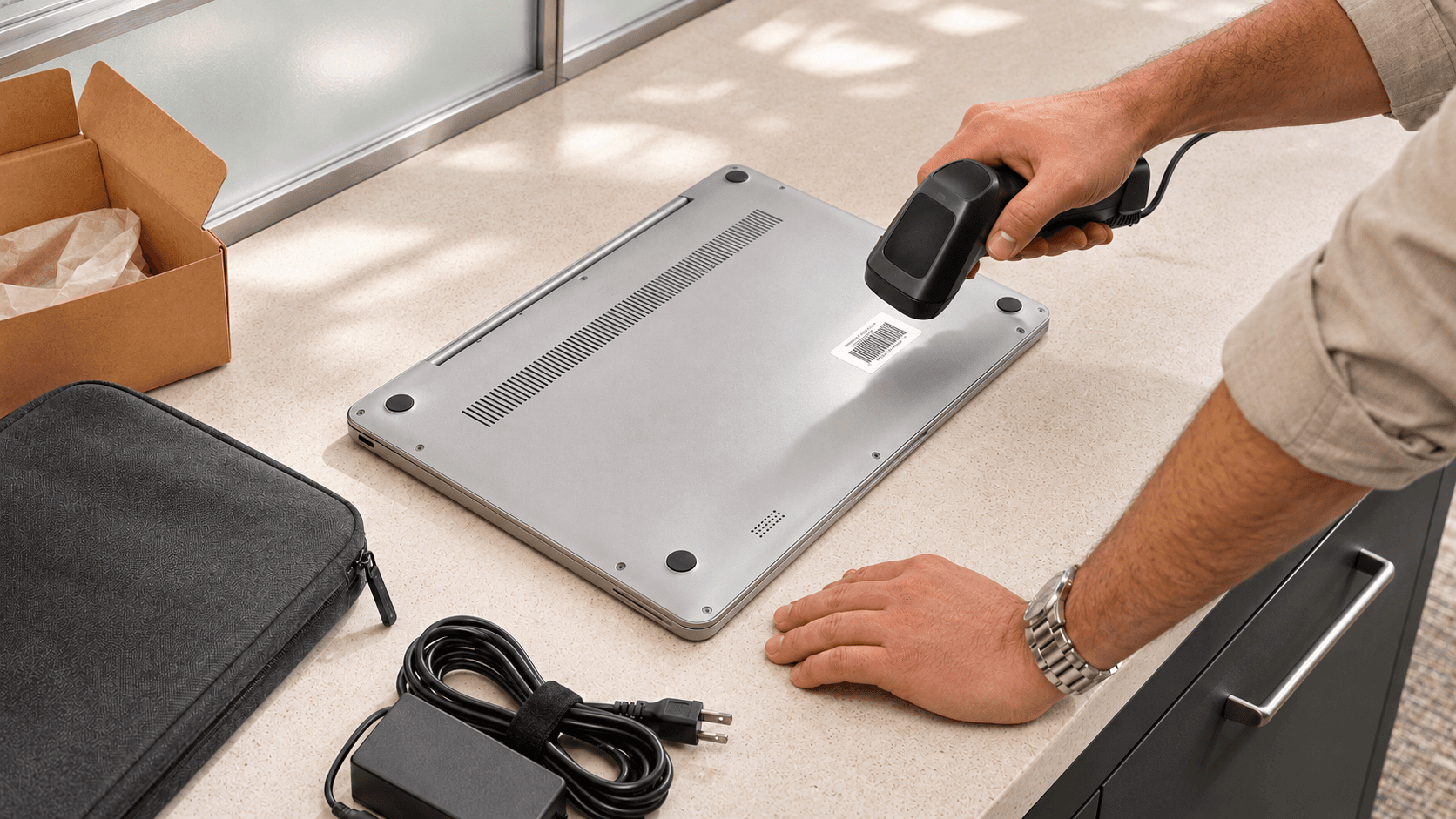
When an employee leaves, the company must address both access to its systems and the information stored on its devices.
These are related but separate activities.
The physical collection of a laptop doesn't automatically establish that its data has been securely removed.
Likewise, remotely disabling access doesn't guarantee that a device has been recovered.
For media sanitisation, the US National Institute of Standards and Technology published NIST SP 800-88 Revision 2 in September 2025.
The guidance focuses on establishing a risk-based media sanitisation programme, including appropriate controls and assurance for reuse or disposal.
A company should determine its sanitisation requirements based on information sensitivity, applicable obligations and the intended disposition of the device.
The operational partner can then perform or coordinate the authorised process and provide the agreed evidence.
This matters whether the laptop is being reassigned internally, returned to a lessor or retired.
How to evaluate an Employer of IT provider
Before choosing a provider, a global IT leader should ask for a clear explanation of how the service works in practice.
The evaluation should cover five areas.
Operational coverage
Which countries and cities are supported?
Which activities can the provider perform directly, and which rely on partners?
Are procurement, deployment, support, repairs and retrieval all included, or priced separately?
Governance
Who approves purchases, exceptions and security-sensitive actions?
What access does the provider require to company systems?
How are responsibilities documented?
Visibility
Can the company track open requests, assigned devices and lifecycle events?
How are asset records updated?
What information can the central IT team review?
Service delivery
What are the support hours and escalation paths?
How are unresolved requests handled?
How are manufacturer delays and stock shortages communicated?
Contract exit
What happens to open tickets and device records if the relationship ends?
How are assets, operational records and any delegated access transferred or revoked?
These questions are useful whether the provider calls its service Employer of IT, managed IT services, co-managed IT or global IT support.
The label matters less than the responsibilities behind it.
How Assetze supports global IT operations for Lyric
Assetze manages global IT operations for Lyric.
That relationship is relevant to the Employer of IT model because it demonstrates Assetze's role as an operational IT partner rather than solely a hardware supplier.
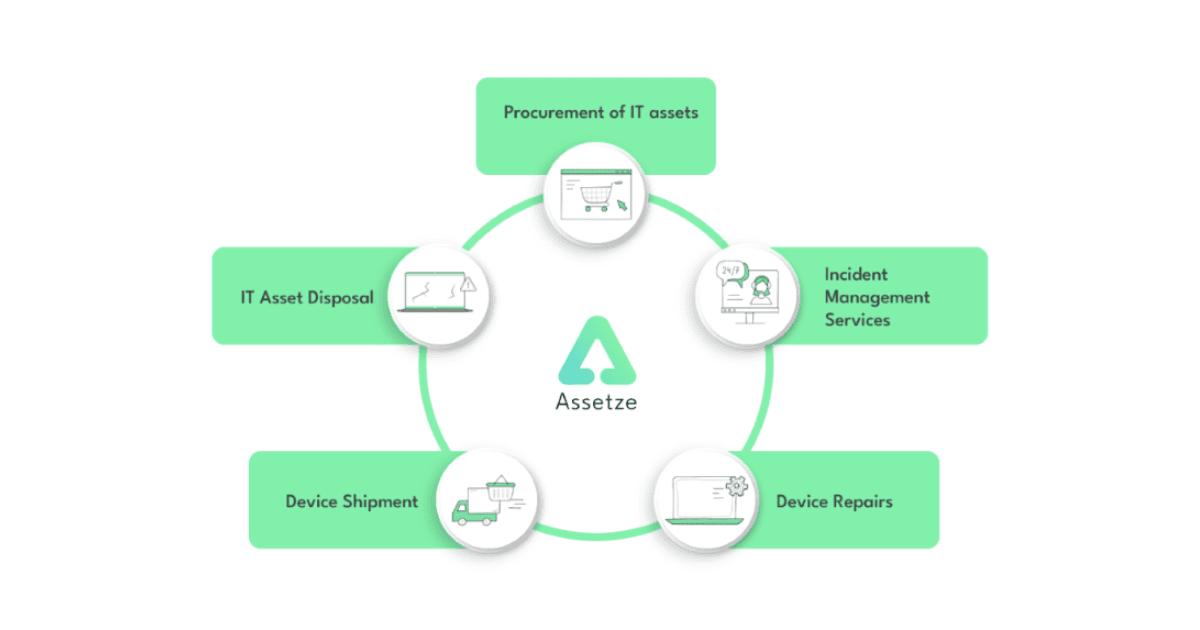
Assetze's broader service offering covers IT procurement and deployment, employee onboarding and offboarding, support, repairs, device retrieval and centralised inventory management.
The Assetze IT Management Platform supports ticketing and asset visibility as part of the service offering.
For global companies, the objective is to connect these activities through a consistent operational relationship.
A laptop purchase, an employee support request and an offboarding retrieval should not require the business to rebuild its vendor coordination process each time.
At the same time, the client should retain authority over its security policies, approved configurations and access decisions.
The company has a team responsible for executing the agreed work and coordinating the next step, with decision-making authority defined in advance.
The specific workflows, countries covered, service levels and outcomes of Assetze's engagement with Lyric are not disclosed here.
When should a global company consider Employer of IT?
An Employer of IT arrangement may be suitable when a company:
- Has employees in India or other locations without dedicated local IT staff
- Manages security and device policies centrally
- Needs physical support that cannot be delivered remotely
- Uses an EOR for employment but needs separate IT operations
- Has difficulty tracking devices across employee onboarding and offboarding
- Wants to reduce the number of operational handoffs involved in employee IT
A company with a strong internal IT presence in every location may not need the same service.
Some businesses may only require procurement and deployment. Others may need ongoing support and full asset lifecycle management.
The right scope depends on the existing IT team, employee locations and the work that needs to be delegated.
Further questions about Employer of IT
Can a US company manage employee laptops in India without a local IT team?
Yes. A US company can use a local IT service provider to carry out agreed procurement, deployment, support and retrieval activities in India while retaining central IT governance. Separate legal and regulatory obligations should still be assessed.
Who is responsible for removing employee access?
The company's authorised identity and security function should control access-removal decisions. A service provider may execute specific tasks only where authority has been delegated.
How is Employer of IT different from a traditional IT helpdesk?
A helpdesk typically focuses on receiving and resolving support requests. An Employer of IT arrangement can cover a broader set of employee IT operations, including procurement, deployment, repairs, asset tracking and recovery.
Does a company need Employer of IT for only a few employees in India?
Not necessarily, but it can be useful if those employees require local device support and the company has no internal IT presence. The decision depends on service requirements and commercial terms.
Give global IT operations a clear owner
For an international company, the challenge isn't always deciding what needs to be done.
The central IT team may already have the right policies, systems and technical expertise.
The harder part is ensuring those decisions are carried out consistently wherever employees work.
A laptop must arrive. A repair must be completed. An asset must be accounted for. A departing employee's device must be recovered.
These are operational responsibilities, not just IT tickets.
Assetze's work managing global IT operations for Lyric reflects the kind of support businesses can use when they need one team to coordinate employee IT across the device lifecycle.
If your company is managing employees across India or internationally, Assetze can help assess which IT responsibilities can be delegated and how they should connect with your existing IT function.
Frequently asked
What is an Employer of IT?
An Employer of IT is a managed service model in which a provider handles agreed employee IT operations, such as laptop procurement, deployment, support, repairs and retrieval, while the client retains control over its IT policies and approvals.
Is Employer of IT the same as Employer of Record?
No. Employer of Record generally concerns employment arrangements and related administration. Employer of IT focuses on the technology and operational support employees need.
Does Employer of IT replace Microsoft Intune or Jamf?
No. Device-management platforms administer endpoints and policies. An Employer of IT provider can coordinate the physical and operational tasks surrounding those devices.
Who owns the laptops under an Employer of IT arrangement?
Ownership depends on the purchase, leasing and contractual arrangements. Using an Employer of IT provider does not automatically transfer ownership of the equipment.
Can an Employer of IT provider handle device retrieval after offboarding?
Yes, retrieval can be included in the service scope. The process should define collection, custody, condition assessment, asset-record updates and any authorised sanitisation or disposition steps.